
In the duty holster market, most marketing copy focuses on aesthetics or “tactical” styling that does not impact the safety or functionality of the gear. To make an informed decision, you should ignore adjectives like “aggressive,” “stealthy,” or “elite.” Instead, focus on load-bearing technical terms: retention levels, locking systems, and material standards. These specifications determine whether a holster remains secure during a physical struggle or shifts during a draw. If a listing lacks specific data on these mechanics, it is likely prioritizing style over the functional requirements of a duty environment.
Duty Holster Retention and Locking Systems
- ALS (Automatic Locking System) – This is the industry standard for passive locking where the holster secures the firearm automatically as it is seated. A positive ALS means the holster remains locked until a specific manual release action is performed.
- SLS (Secure Locking System) – This refers to active locking mechanisms that require a deliberate manual motion to unlock the holster. For high-security needs, a functioning SLS is a primary requirement for preventing unauthorized access.
- Level 1 Retention – This is the lowest tier of security where the holster holds the firearm in place but allows for a quick, easy draw with minimal resistance. It is typically used for training or by users who prioritize speed over high-security requirements.
- Level 2 Retention – This standard provides a balance of security and speed, requiring a firm grip and a deliberate movement to clear the holster. It is a common middle ground for many law enforcement and security applications.
- Level 3 Retention – This is the highest standard of security, requiring a significant amount of force or a specific, complex mechanical action to release the firearm. You should choose Level 3 when the primary requirement is preventing the firearm from being removed during a physical struggle.
- Trigger Interference – This describes an engineering flaw where the holster’s internal geometry allows the trigger to engage during a draw or seating. A “zero interference” rating is the goal; any mention of “safe-to-draw” geometry is a claim that the holster avoids this specific failure mode.
Where these choices show up in our reviews
These 3 have their own full review on this site, and run from $142.40 to $205.99.

Blackhawk Epoch Level 3 Light Duty Holster
$205.99 price checked August 2026
Read our full Epoch Level 3 review
If you own this specific firearm, see our guide to the best duty holster for H&K USP 45.

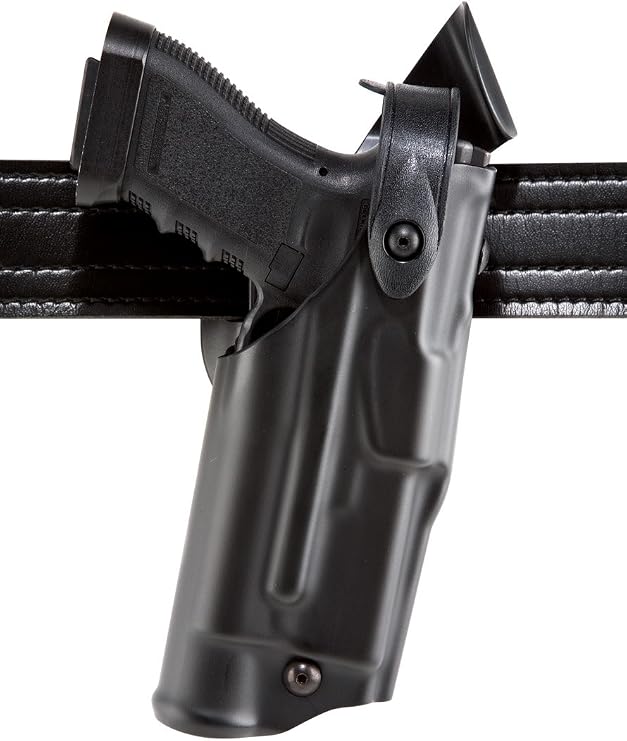
Safariland 6360 ALS/SLS Level 3 Retention Holster
$174.65 price checked August 2026
You can learn more about the different types of duty holsters available on the market.
Duty Holster Materials and Construction
- Kydex – This is a brand name for a class of thermoplastic and a common industry standard for hard-shell holsters. It is preferred for its ability to hold precise shapes and its durability over time.
- Polymer – This refers to molded plastic constructions that are often lighter and more affordable than Kydex. While durable, molded polymer may have less precise retention geometry than thermoformed options.
- 18/10 Stainless Steel – This refers to the chemical composition of the steel used in hardware like clips or buckles. The “18” indicates the chromium content and “10” indicates the nickel content; higher numbers generally indicate better corrosion resistance and durability.
- Canting – This refers to the outward angle at which a holster sits on the belt. A high cant angle can improve access for certain body types, but a “walk” or shift during a draw is a failure mode to avoid.
- Retention Failure – This is a critical failure where the holster gives way under physical pressure. You should look for holsters designed to withstand specific force thresholds to ensure the firearm remains secured during a struggle.
Duty Holster Fit and Compatibility
- Belt Compatibility – This specifies the width of the belt the holster can accept, often measured in millimeters or inches. You must ensure your duty belt width matches the holster’s mounting hardware to prevent the holster from wobbling or shifting.
- Drop Leg Compatibility – This refers to holsters designed to be mounted on a strap around the thigh rather than the waist. These are used when a waist-mounted holster would interfere with a belt-mounted kit or a specific movement profile.
- EDC vs. Duty Fit – “EDC” (Everyday Carry) refers to holsters designed for concealed use with a focus on comfort. “Duty” refers to open-carry holsters designed for high-retention and rapid access. You should prioritize duty-specific geometry if the holster is for professional use.
- Tool Compatibility – This refers to whether the holster is designed to accommodate accessories like weapon lights or lasers. Ensure the “clearance” or “cutout” specifically matches the model of the accessory you plan to use.
Commonly Confused Duty Holster Terms
ALS vs. SLS
While both provide security, ALS is passive (it locks automatically as you put the gun in), whereas SLS is active (it requires a specific manual move to unlock). If you need the highest level of security, the distinction lies in the deliberate nature of the SLS release.
Kydex vs. Polymer
New users should start by viewing how a duty holster works and functions.
Kydex is a thermoformed material that can be molded to exact specifications, while polymer is often injection-molded. Kydex generally offers more precise retention and “click” feel, while polymer offers a lighter weight and lower price point.
Level 2 vs. Level 3 Retention
Level 2 retention is designed to be “fast” but secure, requiring a firm grip to draw. Level 3 retention is designed to be “maximum,” often requiring a specific mechanical release or significant force, making it the standard for high-risk environments.
Cant vs. Walk
A “cant” is a deliberate design choice to angle the holster for better ergonomics. A “walk” is a failure of the holster to stay in place, causing it to shift during a draw. You want a stable cant, not a moving walk.