
There are three meaningfully different types of shoulder holster rigs defined by their harness geometry and retention mechanics. The primary distinction that separates these types is how the rig distributes weight across the torso and how it secures the firearm against movement. While marketing often creates sub-categories based on aesthetics, the functional split rests on whether the rig uses a single-strap scout system, a dual-strap cross-body system, or a specialized harness for specific retention needs.
Scout Style Shoulder Holsters
Scout style shoulder holsters utilize a single strap that runs over the shoulder, typically ending in a loop or a secondary attachment point. This design is for users who prioritize a minimalist profile and a faster draw path from a high-carry position. Because the weight is concentrated on one shoulder, these rigs are best for use with lightweight firearms or for short periods of wear.
The scout style excels at reducing bulk because it lacks the secondary strap and hardware of a full harness. However, it gives up weight distribution; the shoulder and neck must bear the entire load of the firearm and magazine. In the market, these generally sit at the lower end of the price spectrum compared to full harnesses.
Where these choices show up in our reviews
Prices across these 3 run from $28.99 to $65.99; each one has a full review here.
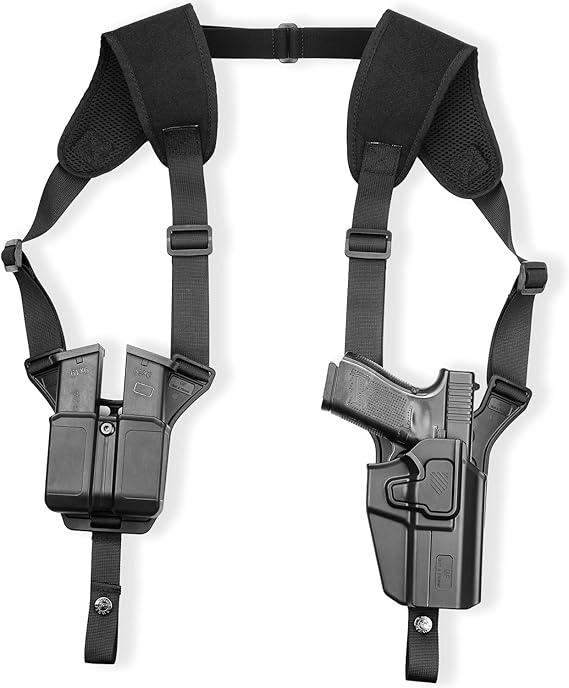

KING HOLSTER Tactical Shoulder Holster for FN 509
$28.99 price checked August 2026
Read our full KING HOLSTER Shoulder Holster review
If you own a classic platform, see our guide to the best shoulder holster for 1911 models.

Cross-Body Shoulder Holsters
Cross-body shoulder holsters use a dual-strap system that crosses the chest or back, distributing the weight of the firearm across both shoulders. This type is for users who need to carry a full-sized duty weapon or who intend to wear the rig for an entire work shift. By splitting the load, the rig reduces fatigue and prevents the holster from shifting as much as a single-strap version might.
Cross-body rigs offer superior stability and comfort for heavy loads, but they are more complex to put on and take off. The extra hardware and leather or nylon required for the dual-strap system place these in a mid-to-high price band. They are the standard choice for professional security roles where the weight of the equipment is a constant factor.
Retention-Focused Shoulder Holsters
Retention-focused shoulder holsters are defined by their specific locking mechanisms, such as thumb breaks, friction fits, or index finger releases. This type is for users who work in high-activity environments where the risk of the firearm shifting or falling out is a primary concern. While a standard holster relies on the tension of the straps, these use mechanical interfaces to lock the firearm in place.
These rigs provide the highest level of security against retention failure, ensuring the firearm remains seated during physical movement. The trade-off is a slightly slower draw time, as the user must manipulate a break or release. Due to the specialized hardware and manufacturing, these often sit at the higher end of the price spectrum.
Comparison of Shoulder Holster Types
| Holster Type | Best-Fit Buyer | Main Advantage | Main Compromise |
|---|---|---|---|
| Scout Style | Lightweight carry/minimalism | Low profile and simplicity | Concentrated weight on one shoulder |
| Cross-Body | Full-duty/long-duration wear | Even weight distribution | More complex to don and doff |
| Retention-Focused | High-activity/high-security | Mechanical security | Slower draw speed |
How to Choose the Right Shoulder Holster Type
To determine which shoulder holster type fits your situation, check your requirements against these three conditions. First, evaluate the weight of your firearm and magazines; if you are carrying a full-sized service weapon, a cross-body shoulder holster is the standard for distributing that weight across both shoulders. If you are carrying a sub-compact and prioritize a low profile, a scout style shoulder holster may be sufficient for your needs.
Second, consider the duration of wear. If you need to remain in a state of readiness for several hours, the dual-strap system of a cross-body rig reduces the risk of the holster sagging or causing discomfort. If the rig is for occasional use, the simplicity of the scout style is often preferred.
Third, assess your movement requirements. If your job involves running, climbing, or rapid physical movement, a retention-focused shoulder holster with a thumb break or friction fit ensures the firearm does not shift. If you primarily move at a walking pace, standard tension-based retention may be adequate. Before ordering, measure your torso width and the height of your firearm, and always consult the manufacturer’s specific size guide for that model.
Browse our other Shoulder Holster pages
- The Shoulder Holster Rigs That Work Best for Budget Beretta 92FS Carry
- Which Shoulder Holster Is Best for Subcompact Pistols?
- Best Shoulder Holster for Deep Concealment
- Concealed Shoulder Holster Rigs for SIG Sauer P226 Compared
- Which Tactical Shoulder Holster Is Best for Concealed Carry?
- Best Shoulder Holster for Smith and Wesson M&P Shield