
A Locking System in a duty holster is the mechanical method used to secure a firearm within the holster and prevent unauthorized removal. Your choice depends on your specific duty requirements, the level of security you need to maintain during a shift, and how quickly you need to access the firearm.
Which Locking System suits my situation?
| If this is you | The Locking System that suits you | Why |
|---|---|---|
| You work in a high-traffic public area where the risk of theft or unauthorized access is constant. | Level 3 Retention | This system requires a deliberate, multi-step manual action to release the firearm, providing the highest security against theft. |
| You are a law enforcement officer who requires a balance between high security and rapid deployment. | Level 2 Retention | This provides a secure lock that can be released quickly with a specific, practiced motion, common in many police agencies. |
| You need to ensure the firearm remains seated during physical struggles or high-movement maneuvers. | Active Locking Systems (SLS) | These systems require a manual motion to unlock, ensuring the firearm stays put until you intentionally initiate the release. |
| You work in a low-risk environment where speed of draw is the primary priority over complex retention. | Passive Locking Systems (ALS) | These systems lock automatically when the holster is seated, requiring no manual interaction to secure the firearm. |
| You are a security professional who needs to carry a firearm but does not require a specialized duty-grade lock. | Level 1 Retention | This provides basic security that keeps the firearm in place during normal movement but offers less protection against intentional removal. |
Duty Holsters we have reviewed in detail
3 reviewed options, $142.02 to $169.84, with the full write-up behind each name.

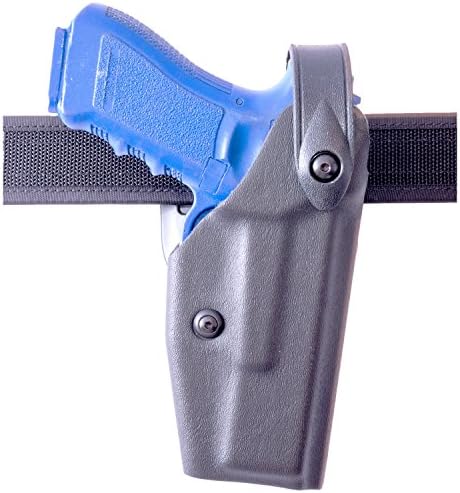
Safariland 6285 SLS Level 2 Retention Holster
$144.35 price checked August 2026
Once you decide on a locking mechanism, you should compare various duty holster carry positions to find your preferred placement.

How do I establish the correct locking system before ordering?
To establish the correct locking system, you must identify your required retention level by comparing your agency’s standards against the manufacturer’s retention hierarchy. Most duty holsters are categorized by Level 1, 2, or 3 retention, which is usually printed in the product specifications or on the manufacturer’s technical data sheet.
Identifying Retention Levels
Check the manufacturer’s documentation for the specific retention tier. Level 1 is generally the baseline, Level 2 involves a more complex mechanical engagement, and Level 3 is the highest tier of security. If your agency does not specify a level, you must determine your own threshold based on the physical environment you work in.
Selecting the right hardware is easier when you evaluate duty holster compatibility options for your specific firearm.
Comparing ALS and SLS
Determine if your workflow requires an Automatic Locking System (ALS) or a Secure Locking System (SLS). An ALS engages the lock automatically when the holster is mounted to a belt or platform. An SLS requires a manual motion, such as a lever flip or a button press, to engage or disengage the lock. You can confirm which type is provided by looking for these specific acronyms in the product descriptions.
What happens if I choose the wrong locking system?
Choosing a locking system that is too high for your needs can result in a failure to deploy the firearm quickly enough during a critical event. If the retention is too complex, the extra seconds required to manipulate the locking mechanism can lead to a delayed response or a missed opportunity to engage a threat.
The risks of over-retention
Over-retention occurs when a user selects a Level 3 system for a role that only requires Level 1 or 2. In practice, this shows up as a “fumble” where the user struggles to clear the locking mechanism under stress. This can lead to a negligent discharge if the user attempts to force the firearm out of a locked holster.
The risks of under-retention
Under-retention occurs when the locking mechanism is too easy to bypass or does not provide enough security for the environment. If a holster has insufficient retention, the firearm may “walk” or shift out of the holster during a physical struggle. This creates a safety liability where the firearm could be removed by an adversary or fall out of the holster entirely.
What should I do if I fall between two locking levels?
If you fall between two locking levels, you should choose the higher retention level that you can still operate proficiently during training. Because the difference between Level 2 and Level 3 is often a matter of the number of motions required, your decision should be based on your ability to perform those motions under pressure.
The training requirement
If you are unsure if you can master a higher retention level, seek out a training environment that simulates the stress of your duty. If you can successfully clear the lock in a timed drill, the higher retention is appropriate. If you consistently struggle to clear the lock during training, you should move down to the lower retention level to ensure reliability.
Confirming local requirements
Before ordering, confirm the specific requirements for your location or agency. Rules regarding retention levels and locking mechanisms can vary by state, city, or department. Ensure your choice complies with all local regulations before making a final purchase.