
When shopping for a shoulder holster rig, distinguishing between functional specifications and marketing fluff is essential for making a practical purchase. Load-bearing terms focus on how the rig retains the firearm, how it sits against the body, and the materials used to ensure the gear does not shift or fail during movement. Marketing vocabulary often emphasizes “tactical” aesthetics or “military-grade” labels that lack specific engineering definitions. You should prioritize technical details regarding retention types, harness configurations, and material thickness over subjective descriptors like “elite” or “advanced.”
Shoulder Holster Rig Retention Mechanisms
Retention mechanisms determine how securely a shoulder holster rig holds the firearm in place during physical activity.
- Friction Fit – This relies on the snugness of the holster’s interior against the firearm’s frame to keep it from moving. A tighter fit is generally better for smaller frames, while larger firearms may require more robust mechanical retention.
- Thumb Break – This involves a physical flap or strap that the user flips over the grip or slide with their thumb. A positive, audible click or firm seat of the break is a superior indicator of security over a loose flap.
- Index Finger Release – This mechanism allows the user to release the holster by placing a finger on a specific trigger-like lever. This provides the fastest release but requires a precise fit to ensure the firearm does not shift before the lever is engaged.
- Retention Strength – This refers to the amount of force required to pull the firearm from the holster. While high retention is desirable for security, it must be balanced against the ease of the draw; a value that is too high can cause “friction drag” or a “hang-up” on the slide.
Where these choices show up in our reviews
These 3 have their own full review on this site, and run from $26.99 to $28.99.


King Holster Tactical Shoulder Holster Beretta Px4 Storm
If you need a low-profile setup, view our roundup of deep concealment shoulder holsters.
$0 price checked August 2026
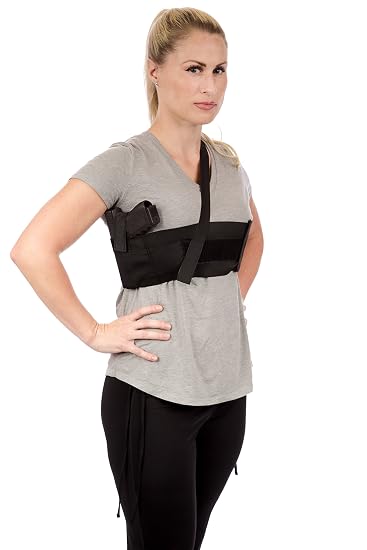
Shoulder Holster Rig Harness and Carry Styles
The harness style dictates how the weight of the holster rig is distributed across the torso and shoulders.
You can also learn about different styles of shoulder holster designs to find your preferred configuration.
- Single-Strap (Scout) Style – This configuration uses one wide strap that passes over the shoulder. It is simpler to put on but may shift more easily than dual systems during high-intensity movement.
- Dual-Strap (Cross-Body) System – This uses two straps that cross over the chest or back to distribute weight. A dual-strap system is generally superior for stability and weight distribution, especially when carrying heavier firearms.
- Adjustable Harness – This refers to the presence of sliders or buckles that allow the rig to be sized to your specific torso. A wide range of adjustment is better for ensuring the rig sits at the correct height to avoid “printing” through clothing.
- Shoulder Pad – This is a cushioned area where the strap rests on the trapezius muscle. A thicker, high-density foam pad is better for preventing the strap from digging into the shoulder during long periods of wear.
Shoulder Holster Rig Material and Construction
Material specifications define the durability, weight, and “print” profile of the holster rig.
- Kydex – This is a thermoplastic polymer used to create rigid, molded holsters. It offers high retention and consistent sizing, making it a standard for modern, durable rigs.
- Leather – This natural material is often used for its ability to mold to the specific shape of a firearm over time. High-quality, thick-cut leather is durable, but it requires a break-in period to achieve a custom fit.
- Nylon Webbing – This is the fabric used for the straps. A higher “denier” (thickness) count indicates a stronger, more abrasion-resistant strap that will not stretch or fray over time.
- Open-Top Design – This refers to a holster where the top is not covered by a flap. It allows for a faster draw but exposes more of the firearm’s slide and barrel.
- Closed-Top Design – This features a cover over the top of the holster. A closed-top design is better for preventing debris from entering the holster and for providing a more concealed profile.
Shoulder Holster Rig Fit and Alignment Terms
Fit and alignment terms describe how the rig interacts with the user’s body and the firearm’s draw path.
- Print – This refers to the visible outline of the holster or firearm through clothing. A “low-profile” design is one engineered to minimize this, and a smaller, more contoured holster is better for achieving a concealed look.
- Cant Angle – This is the degree to which the holster tilts toward the side of the body. The cant angle must match the user’s natural draw path; if the angle is too steep or too shallow, it can cause the firearm to stick during the draw.
- Draw Clearance – This is the amount of space available for the hand to enter the holster. A larger clearance is easier for the user but may increase the “print” of the rig; a balanced clearance is the goal for shoulder rigs.
- Weight Distribution – This refers to how the rig balances the weight of the firearm against the body. A rig that pulls the shoulder backward or forward is poorly balanced; a neutral weight distribution is better for long-term comfort.
Commonly Confused Shoulder Holster Terms
Buyers often confuse these terms because they sound similar but result in very different carry experiences.
Friction Fit vs. Retention Mechanism
A friction fit is a specific type of retention that relies on pressure. A “retention mechanism” is a broader category that includes friction fits, thumb breaks, and finger releases. If you need maximum security, a mechanical thumb break is a distinct upgrade over a simple friction fit.
Scout Style vs. Cross-Body
A scout style is a single-strap system, while cross-body refers to a dual-strap system. While both are shoulder rigs, the cross-body system is designed for better stability and weight distribution, whereas the scout style is designed for simplicity and ease of donning.
Kydex vs. Molded Leather
Kydex is a synthetic plastic that provides a “set” shape immediately. Molded leather is a natural material that is shaped through use. Kydex is better for consistent, repeatable retention, while molded leather is often preferred by those who want a custom-molded feel that conforms to their specific grip.
Print vs. Ride
“Print” refers to the holster being visible through clothing. “Ride” refers to how the holster sits on the body (e.g., high on the chest vs. low on the ribs). A rig can have a good “ride” (it stays in place) but still “print” (it is visible). You must evaluate both for a successful concealed carry setup.
Browse our other Shoulder Holster pages
- Which Tactical Shoulder Holster Is Best for Concealed Carry?
- Best Shoulder Holster for Smith and Wesson M&P Shield
- Budget Shoulder Holster Rigs for Glock 17 and 19 Compared
- Choosing the Best Shoulder Holster for 1911 Models
- The Shoulder Holster Rigs That Work Best for Budget Beretta 92FS Carry
- Which Shoulder Holster Is Best for Subcompact Pistols?